Choose your region and language
ApplyTile spacers: which ones do you need and how do you use them?
Reading time ± 4 minutes
Tile spacers, also known as grout spacers, help you install wall and floor tiles with a consistent grout joint width. By positioning the spacers between the tiles or at the tile corners, you can maintain consistent spacing between the tiles and follow your chosen tile pattern accurately throughout the installation.
The type of tile spacer you need mainly depends on the tile pattern, the required grout joint width and the application. Classic X-shaped spacers are used where four tile corners meet, while T-shaped spacers are suitable for tile patterns where three tile corners meet. Multifunctional and reusable tile spacers and tile wedges are also available for specific applications.
Levelit offers a range of tile spacers for different tiling projects.
Why use tile spacers?
When installing tiles, it is important to maintain consistent spacing between them. Tile spacers help you achieve this by acting as spacers between the tile edges during installation.
With the right tile spacer, you can:
- maintain a consistent grout joint width between the tiles;
- position tiles correctly in relation to one another during installation;
- maintain the chosen tile pattern consistently across the tiled surface.
The thickness of the tile spacer determines the distance between the tiles. In addition to choosing the right size, the shape of the spacer is also important.
Which type of tile spacer do you need?
Not every tile pattern requires the same type of spacer. First consider how the tiles will be positioned in relation to one another.



Classic tile spacers
Classic tile spacers are X-shaped and are used where four tile corners meet. They help maintain the same spacing between the tiles both horizontally and vertically. These tile spacers are suitable for a standard grid pattern, among other layouts, with both wall and floor tiles.
T-shaped tile spacers
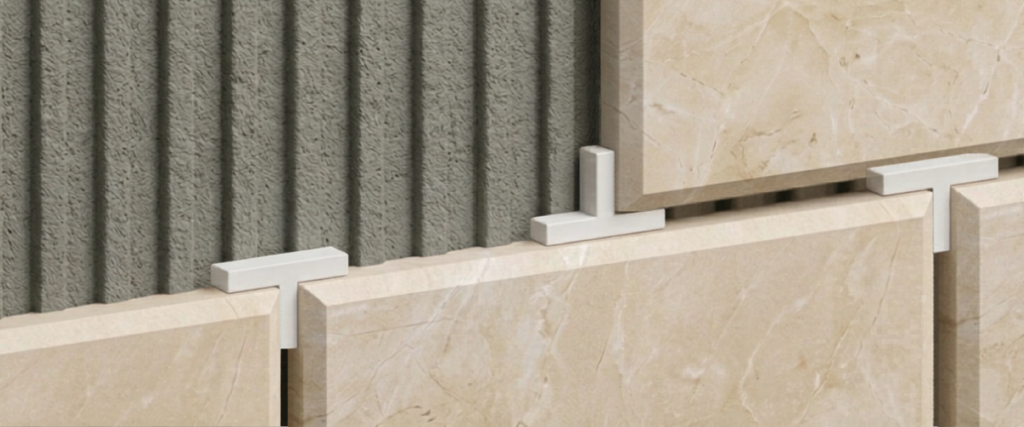
For tile patterns where three tile corners meet, you can use T-shaped tile spacers. Their T-shape follows the grout joint pattern and makes them suitable for staggered tile patterns, such as a running bond pattern. This allows you to maintain a consistent grout joint width even with staggered joints.
Multifunctional tile spacers
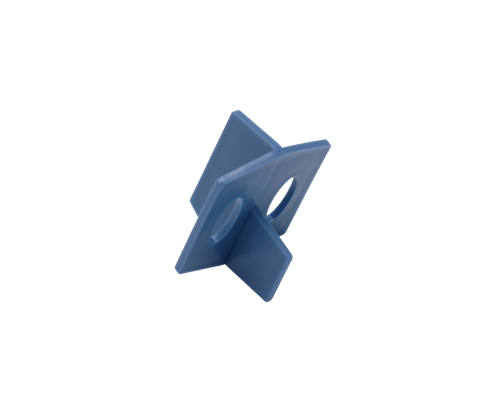
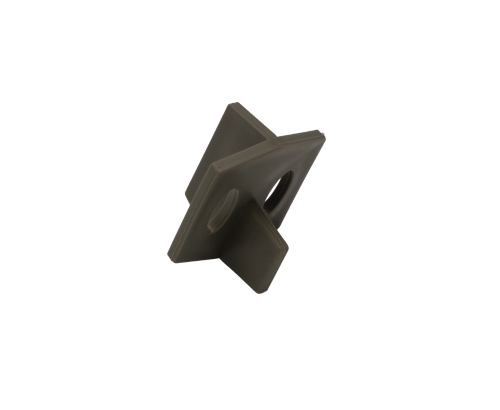
Multifunctional tile spacers combine several applications in a single spacer. Depending on their position, they can be used as an X-, T- or I-shaped spacer. This is particularly practical when different joint configurations occur within the same tiling project, as you do not need to switch between different types of spacers.
Reusable tile spacers
Reusable tile spacers are designed to be removed after use and reused for another tiling project. They are particularly useful if you regularly install tiles and want to use the same grout joint width across different projects.
Tile wedges
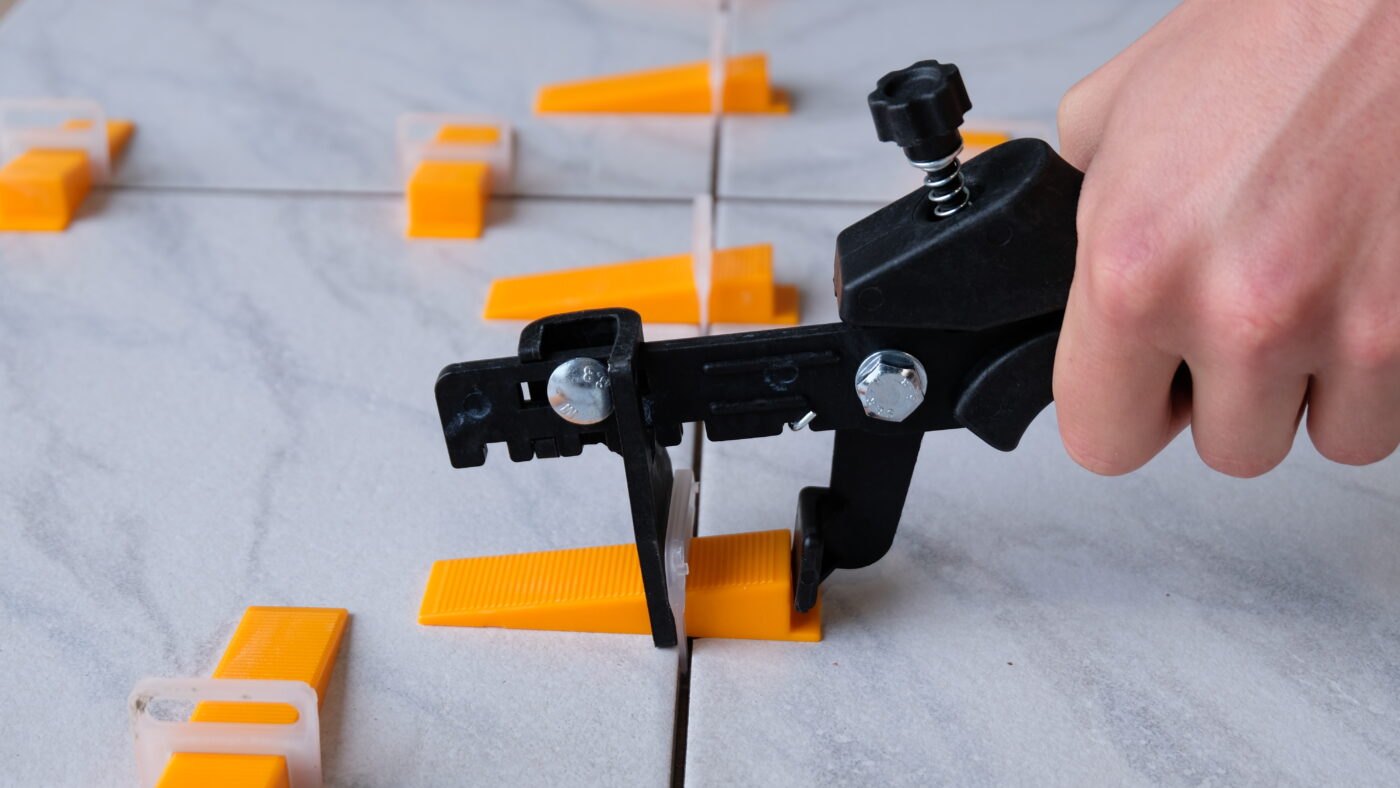
Tile wedges differ from standard tile spacers because their thickness gradually increases. This allows you to adjust the spacing or position of tiles more precisely during installation. Levelit tile wedges range from 0 to 5 mm and are particularly useful for positioning and aligning wall tiles.
What size tile spacer do you need?
The thickness of the tile spacer determines the distance between the tiles and therefore the final grout joint width. For a 2 mm grout joint, for example, you use a spacer that creates a 2 mm gap between the tiles.

The appropriate grout joint width depends on several factors, including:
- the type of tile;
- the dimensional accuracy of the tiles;
- the chosen tile pattern;
- the application;
- the instructions provided by the tile and adhesive manufacturers.
Rectified tiles can generally be installed with narrower grout joints than tiles with greater dimensional variations. Floors, outdoor applications and installations with underfloor heating may also be subject to specific requirements.
You should therefore not choose a grout joint width based solely on the desired appearance. Always take the technical requirements of the tiling project into account as well.
Please note: not every type of Levelit tile spacer is available in every grout joint width. Always check the available sizes within the chosen product category.
How do you use tile spacers?
Tile spacers can be used when installing a tiled floor, bathroom wall or kitchen wall, for example.
Follow these steps:
- Apply the tile adhesive and position the first tile.
- Place the tile spacers between the tile edges or at the tile corners, depending on the chosen tile pattern.
- Position the next tile against the spacers.
- Regularly check the grout joint width and alignment as you work.
- Continue in the same way across the entire tiled surface.
- Remove spacers that are designed to be removed at the appropriate time and in accordance with the instructions for use.
- Allow the tile adhesive to cure sufficiently according to the manufacturer’s instructions before grouting the joints.
Use a classic X-shaped spacer where four tile corners meet and a T-shaped spacer where three tile corners meet. If your tiling project includes different joint configurations, a multifunctional tile spacer can be a practical solution.
Tile spacers or a tile levelling system?
Tile spacers and tile levelling systems do not serve the same purpose. Tile spacers are primarily used to maintain consistent spacing and grout joint widths between tiles during installation. A tile levelling system also helps reduce height differences between adjacent tile edges during installation. Depending on the tiling project, the two tools can therefore serve different purposes.
Would you like to know exactly how a tile levelling system works and why you should use one? Read our blog Tile levelling system: what is it and why should you use one?.
Find the right tile spacer for your project
From a standard grid pattern to a staggered tile layout, the right spacer helps you maintain the required grout joint width consistently during installation.
First determine which tile pattern you are using and which grout joint width you need. You can then choose between classic tile spacers, T-shaped spacers, multifunctional or reusable spacers and tile wedges.
Explore the complete range of tile spacers and choose the type and size that suit your tiling project.
Do you have questions about choosing the right spacer or grout joint width? Feel free to contact us. Our team will be happy to help.
Related articles
Professional mortar mixer: Levelit MIX 1800 force

Spike roller for self-levelling compound: which one do you need?
