Choose your region and language
ApplySpike roller for self-levelling compound: which one do you need?
Reading time ± 4 minutes
When applying self-levelling compound or levelling mortar, air bubbles can form in the material. If these air pockets do not escape sufficiently, they may remain visible as small holes, pinholes or irregularities in the surface. A spike roller helps remove trapped air from the fresh levelling layer and promotes an even flow of the material.
The spike roller you need depends, among other things, on the size of the floor area and the thickness of the levelling layer. In this article, we explain why you should use a spike roller, when to use it and which width is best suited to your project.
Why use a spike roller with self-levelling compound?
During the mixing and application of self-levelling compound, small air bubbles or air pockets can become trapped in the material. Air can also remain in the layer while the compound is being poured and spread.
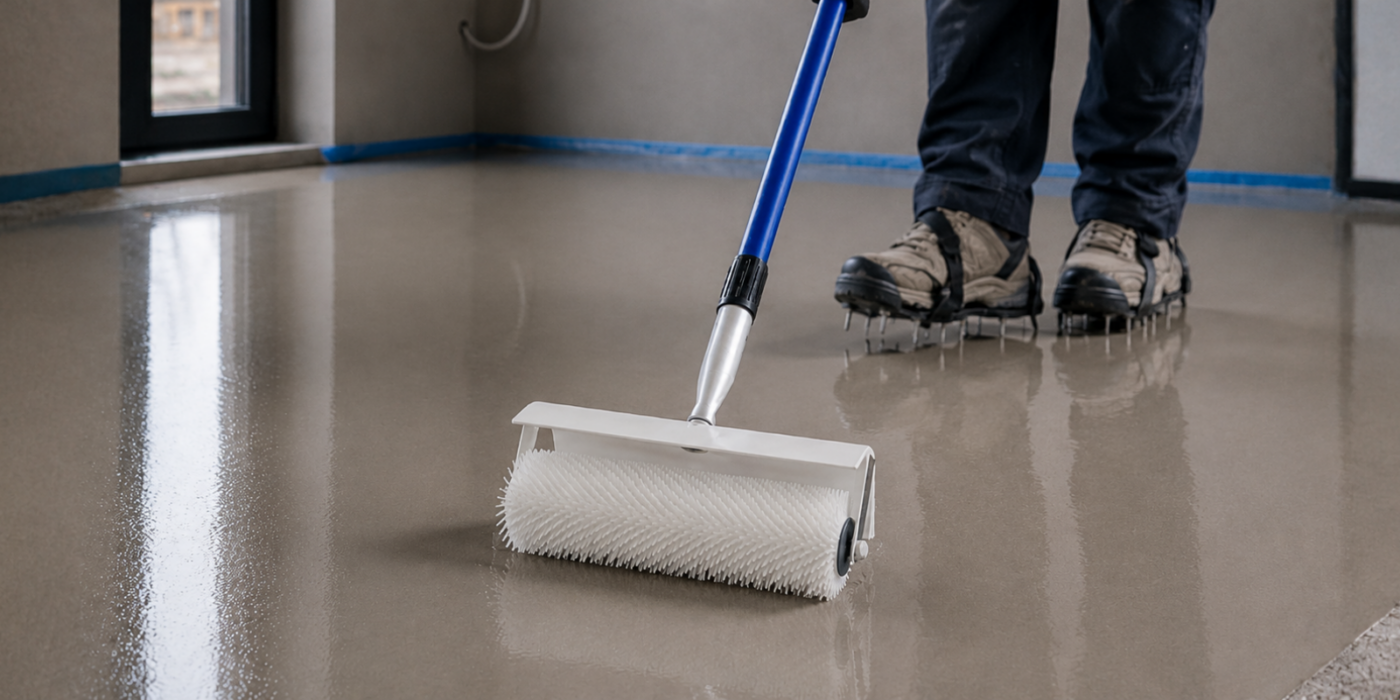
By rolling a spike roller over the freshly applied self-levelling compound, you help bring this trapped air to the surface. The spikes move through the compound while it is still fluid and also help the material flow more evenly.
A spike roller therefore helps to:
- reduce trapped air and the resulting air holes or pinholes in the levelling layer;
- help the self-levelling compound flow more evenly.
A properly levelled surface provides an important base for the subsequent installation of floor coverings or tiles.
When should you use a spike roller?
A spike roller is used after the self-levelling compound has been applied and spread across the floor, while the material is still sufficiently fluid. Rolling over the fresh levelling layer at the right time allows trapped air to escape more easily.
It is important to work within the specified working time of the levelling product. Once the self-levelling compound begins to set, rolling can disturb the surface instead.efficiently without disturbing the freshly applied layer. The result is an even and homogeneous surface, ready for further finishing.
Which spike roller do you need?
The most suitable spike roller mainly depends on the size of the surface and the available working space. A narrower roller provides greater control in small spaces and around obstacles, while a wider roller is more efficient for larger floor areas.
230 mm spike roller
The 230 mm spiked roller is compact and easy to manoeuvre. This makes it particularly suitable for smaller areas and spaces with limited room to move, such as toilets, small bathrooms and areas with many corners or obstacles. Its narrower working width allows for greater precision and makes it easier to reach areas where a wider spike roller would be less practical.
250 mm spike roller
The 250 mm spiked roller is a versatile choice for small to medium-sized floor areas, such as bathrooms and kitchens. Its working width provides a good balance between manoeuvrability and efficiency, making it suitable for a wide range of levelling applications. This model also features a zinc alloy holder and integrated splash guard.
500 mm spike roller
For larger floor areas, the 500 mm spiked roller is the most efficient choice. Its wider working width allows you to cover a larger area with each pass. This makes it particularly suitable for larger living spaces, garages and commercial areas. The 500 mm model also features a zinc alloy holder and integrated splash guard.
Which spike length do you need for self-levelling compound?
The spike length of a spike roller determines how deeply the spikes move through the levelling layer and should therefore be matched to the layer thickness. If the spikes are too short, the layer will not be deaerated deeply enough. If they are too long, they may reach the substrate and disturb the levelling layer.
As a general guideline, you can use the following spike lengths:
- 11 mm spikes: for thin levelling layers of approximately 2 to 5 mm.
- 21 mm spikes: for medium-thickness levelling layers of approximately 5 to 15 mm.
- 31 mm spikes: for thicker levelling layers of approximately 15 to 25 mm.
The correct spike length allows the spikes to move deep enough through the self-levelling compound to release trapped air. Spikes that are too short may not reach air pockets deeper in the layer, while spikes that are too long may reach the substrate and disturb the surface.
Always check the layer thickness of the levelling product being used and follow the manufacturer’s application instructions.
Less splashing thanks to an integrated splash guard
When using a spike roller on fresh self-levelling compound, the material can splash. Some spike rollers are therefore fitted with a splash guard, which helps reduce splashing while rolling. This can be particularly useful on larger surfaces and helps keep the immediate working area cleaner.
Working ergonomically with a telescopic pole
For larger floor areas, you can combine a spike roller with a telescopic pole. This allows you to reach a larger area without constantly bending over. A telescopic pole also makes it easier to move the roller across the fresh levelling layer without having to walk over the treated surface.
Which spike roller should you choose?
The right spike roller primarily depends on the size of the floor area you are working on:
- 230 mm: for small areas, corners and hard-to-reach spaces;
- 250 mm: a versatile size for small to medium-sized areas;
- 500 mm: for larger floor areas where greater working efficiency is important.
You should also consider the thickness of the levelling layer and choose the spike length accordingly. For layers of approximately 2 to 5 mm, use 11 mm spikes; for 5 to 15 mm, use 21 mm spikes; and for 15 to 25 mm, use 31 mm spikes.
This allows you to choose a spike roller that suits both the size of the surface and the thickness of the levelling layer, helping to create an even base for the subsequent floor finish.
Discover our solutions for floor levelling and explore Levelit’s complete range of tiling tools.
Related articles
Professional mortar mixer: Levelit MIX 1800 force

PowerGrip USB suction cup: maximum control for large-format tiles
