

FREQUENTLY ASKED QUESTIONS
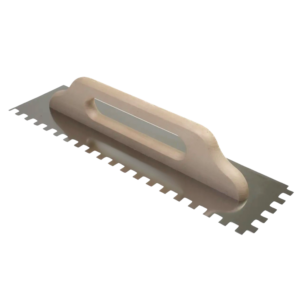
Have questions about notched trowels? Below you’ll find answers to common questions about trowel sizes, notch sizes, materials and applying tile adhesive correctly.
- Which size of notched trowel should I choose?
The width of the notched trowel mainly affects working speed and manoeuvrability. A compact trowel offers greater control in smaller areas, while a wider trowel allows tile adhesive to be spread more efficiently over larger surfaces.
LEVELIT offers compact 180 mm notched trowels, standard 280 mm notched trowels and extra-wide 480 mm notched trowels. Choose the size that best suits the working area and application. - Which notch size should I choose?
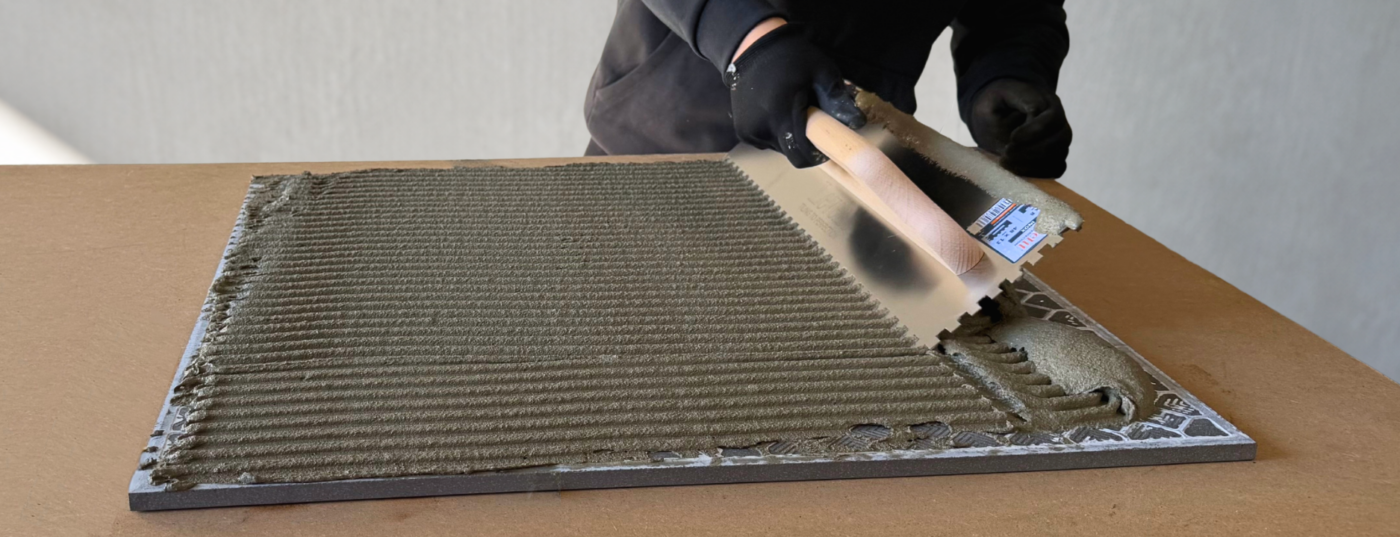
The required notch size depends on several factors, including the tile format, the profile of the tile back, the flatness of the substrate and the required adhesive coverage. Larger tiles generally require a larger notch, but tile size alone should not determine your choice.
Tile size Indicative notch size Up to 10 x 10 cm 3 – 4 mm 10 x 10 cm to 30 x 30 cm 6 mm 30 x 30 cm to 60 x 60 cm 8 mm 60 x 60 cm and larger 10 – 15 mm These sizes are indicative only. Always follow the tile adhesive manufacturer’s instructions and check that the required adhesive coverage is achieved.
For large-format tiles, back-buttering may also be required to achieve sufficient adhesive coverage. This involves applying adhesive to the back of the tile in addition to the substrate. It can help achieve the required adhesive coverage and reduce voids beneath the tile.
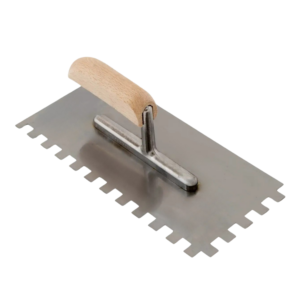
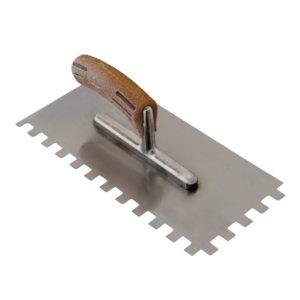
- Should I choose a stainless steel or steel notched trowel?
Both stainless steel and steel notched trowels are suitable for spreading and combing tile adhesive. The main differences are corrosion resistance and maintenance.
Stainless steel offers high corrosion resistance and is easy to maintain, making it well suited to frequent professional use. Regular cleaning after use helps maintain the blade and prolong the life of the tool.
Steel provides a durable and practical option but requires more careful cleaning and dry storage to help prevent corrosion.
Whichever material you choose, clean the trowel thoroughly after use and remove any adhesive before it hardens.